DECISION POINT LEADERSHIP GROUP — LEADERSHIP BEFORE THE CONSEQUENCE
THE MOMENT BEFORETHE OUTCOME IS WHERELEADERSHIP MATTERS MOST.
Most organizational failures don’t begin with one catastrophic decision. They develop through smaller moments when someone could’ve intervened, corrected course, communicated, escalated, or stopped the problem. Decision Point Leadership Group helps leaders recognize those moments before options disappear and consequences become expensive.
THE PATHWAY
EVERY OUTCOME TRAVELSA SEQUENCE OF MOMENTS
Select any stage. Interruption is where leadership may still change the trajectory.
04 — INTERRUPTION
Where leadership receives an opportunity to change the trajectory. New information, a complaint, a warning — a door that is still open.
THE PROBLEM
THE PROBLEM ISN’T ALWAYSTHE FINAL DECISION.
It’s everything leadership allowed to happen before it.
A performance issue goes unaddressed.
A safety concern gets postponed.
A standard slowly becomes optional.
A talented employee stops speaking up.
A supervisor avoids a difficult conversation.
Leadership ignores an early warning.
One compromise creates another.
A manageable problem becomes an expensive one.
By the time leadership asks, “How did we get here?” the organization may have already passed several Decision Points.
THE FRAMEWORK
THE DECISION POINTPRINCIPLE
The Decision Point Principle is a framework for examining the meaningful moments between a developing situation and its eventual outcome. Instead of evaluating failure only after the consequences appear, the framework teaches leaders to identify the moments when choices can still change the trajectory.
At every meaningful Decision Point, a leader may have the opportunity to:
Leadership isn’t only about making the right decision.
It’s about recognizing when the decision needs to be made.
THE SIGNATURE FRAMEWORK
THE SIXDECISION POINTS
A practical map of every developing situation — and the moments where leadership still has room to act.
Where leadership receives an opportunity to change the trajectory. New information, a complaint, a warning — a door that is still open.
BUSINESS IMPACT
BETTER DECISIONS BEFOREEXPENSIVE CONSEQUENCES
Decision Point Leadership Group helps organizations strengthen the leadership behaviors that determine whether small problems stay small.
The goal is to help organizations recognize preventable problems earlier, preserve more options, and equip leaders to act before situations become significantly harder to correct.
HOW WE HELP
ENGAGEMENTS BUILT AROUNDYOUR DECISION POINTS
WHO WE WORK WITH
BUILT FOR ENVIRONMENTS WHEREDECISIONS HAVE CONSEQUENCES
The Decision Point framework is especially valuable in environments where leadership choices directly affect people, safety, culture, performance, and organizational outcomes.
REAL-WORLD DECISION POINTS
SAME SITUATION.DIFFERENT DECISIONS.DIFFERENT OUTCOMES.
Select a response in each scenario to see how different decisions create different downstream consequences.
A high-performing employee begins arriving late.
Decision Point:
Choose a response to trace the consequence.
A supervisor receives repeated complaints about a team member.
Decision Point:
Choose a response to trace the consequence.
A safety procedure begins getting skipped because “everyone knows how to do it.”
Decision Point:
Choose a response to trace the consequence.
Every organization has Decision Points. The question is whether its leaders recognize them.

LORENZO L. SELLERS
Founder & Lead Strategist

On stage — live keynote
THE FOUNDER
BUILT FROM LEADERSHIP WHEREDECISIONS HAVE CONSEQUENCES
Lorenzo L. Sellers is the Founder and Lead Strategist of Decision Point Leadership Group and creator of the Decision Point Principle. His leadership philosophy developed through years of leading people, developing personnel, enforcing standards, managing accountability, and operating in environments where decisions carried real consequences.
That philosophy eventually evolved into the Decision Point Principle — a framework for understanding the moments where choices become consequences and where leadership may still change the outcome.
- National Bestselling Author
- Creator of The Decision Point Principle
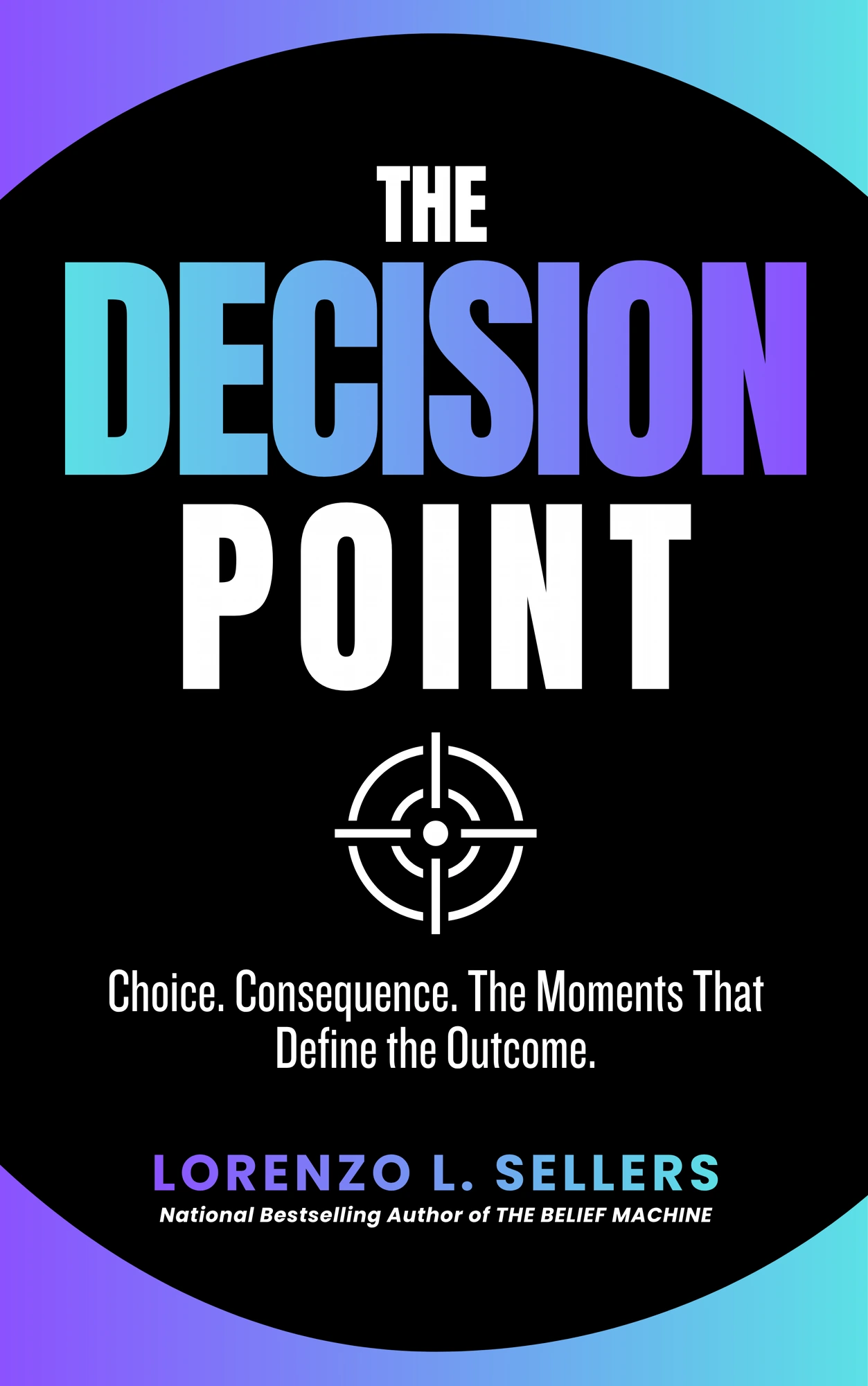
- Author of The Decision Point: Choice. Consequence. The Moments That Define the Outcome.
THE BOOK
THE IDEA BEHINDTHE WORK
THE DECISION POINT
Choice. Consequence. The Moments That Define the Outcome.
The Decision Point explores a simple but powerful idea: major outcomes are often not created by one decision. They’re built through a sequence of moments when someone could’ve continued, stopped, intervened, changed direction, or escalated.
The book examines choice, consequence, responsibility, leadership, psychology, relationships, organizations, and the moments that ultimately shape outcomes.
“THERE’S ALWAYS A CHOICE,AS LONG AS YOU CAN DEAL WITHTHE CONSEQUENCESOF THOSE CHOICES.”
— Lorenzo L. Sellers
FREE ASSESSMENT
THE DECISION POINTLEADERSHIP CHECK
10 Questions That Reveal Where Leadership Problems May Be Escalating Inside Your Organization.
- 01 Do your leaders know who owns the response when a small problem surfaces?
- 02 Are standards enforced consistently — or quietly optional?
- 03 Do high performers feel safe raising uncomfortable truths?
- …and 7 more inside the assessment.
YOUR ORGANIZATION WILL HAVEANOTHER DECISION POINT.
The question is whether your leaders will recognize it.